Dial 'M' for Misinformation
For almost two years, prosecutors and media outlets have played Telephone at the expense of Luigi Mangione and the US Constitution. Please hold while we connect you.

Telephone begins simply enough: one person whispers a perfectly innocuous line in somebody else’s ear.
That person repeats what they heard to the next player.
The one after that embellishes it ever so slightly, maybe because they misheard, or perhaps, consciously or subconsciously, they want the message to be different.
And once it’s passed through all the players, “the cat took a lazy nap” becomes “the cat hijacked a grandmother’s plane on a Tuesday.”
The message is tangled, barely contains any of the original wording, and certainly no longer resembles the original meaning. Researchers in social psychology call this the transmission chain, with cultural psychologists studying the phenomenon of the transmission chain method: how and why biases transform information as it travels.
The game of Telephone is not a new concept. We’ve all played it in the school playground, but like most childhood games, we grow out of it pretty quickly. Media and law enforcement, on the other hand…
Whether it’s headlines forced to skip out on important context, outlets prioritising speed over accuracy, or certain briefs deliberately misrepresenting the facts, many outlets are not reporting the full story. How Luigi Mangione and his three(!) criminal cases have been represented in the national press and by law enforcement is only the most recent stunning example of this system and all of its flawed incentives in action.
In a letter filed today (July 31 2026), Luigi’s defense team objected to a set of guidelines governing press access to his upcoming trial: No overflow courtroom, only six journalists for jury selection, and general access limited to just 68 reporters.
And how are these reporters selected? Through a process outsourced to a single attorney with a history of representing legacy media outlets, of course. Never mind the independent journalists vying for a spot in the room, whose interest, research and competition bring exactly the remedy required for a monopolized and nepotistic access pipeline.
Agnifilo Intrater says it only learned of the plan after a journalist posted about it on social media. Not the first time the courts have played Telephone with the defense instead of the audience, and likely not the last.
Let’s play a game of Telephone
In the early days of the investigation into the events of December 4 2024, NYPD Chief of Detectives Joseph Kenny told journalists, who then reported it in national outlets, that investigators had reached out to Luigi’s mother, after a San Francisco officer came across a missing persons report for him filed in November 2024, and claimed that she said:
“it [the shooting] might be something that she could see him doing.”
In fact, People magazine reported this to their more than 10 million Instagram followers, on December 18 2024, with a headline saying “Luigi Mangione’s mother told FBI she ‘could see him’ shooting UnitedHealthcare CEO.” And in the month following Luigi’s arrest, 249 articles were published in US national media containing the words “Luigi Mangione,” and “mother.”
Please hold for a slow clap.
Why do we bring this up? Because twelve months later in December 2025, Luigi’s lead defense attorney, Karen Friedman Agnifilo, corrected the record following receipt of discovery. No such statement appears anywhere in discovery materials turned over by the District Attorney’s office or NYPD. In fact, what his mother had said was quite the opposite: that she could not see her son being a risk to himself or others.
The prosecution has never denied the correction from the defense team, and yet no media outlet has retracted their incorrect reports.
Now, one misreport or one misspoken sentence can be chalked up to static on the line. When it becomes a pattern, though, it starts to look less like accidental errors and more like deliberate attempts to diverge from reality, in order to create negative connotations about a defendant in the public’s mind - and, the minds of potential jurors. Quelle surprise!
According to the original criminal complaint, when officers asked Luigi if he’d recently been in New York, he “became quiet and started to shake.” Altoona Deputy Chief of Police Derek Swope said at a press conference on the day of Luigi’s arrest that the question “invoked a physical reaction from the suspect…he became visibly nervous…that state of alarm really said a lot.” In other words, they were implying his body language gave away a guilty conscience.
However, bodycam footage shown during suppression hearings portrays Luigi quietly eating a hash brown, calmly responding to the officers’ questions, and politely communicating with them. There were no signs of nervousness or shaking.
So why the false reports? Even if it had been true, it’s hardly unusual for a person being stopped by the police to get a little nervous, fearing they’re in trouble for something but not sure what. Caution after being approached by officers is a common occurrence and not something the police would be alarmed by. Nevertheless, it seems a form of conscious bias took over.
Wrong number
Around the same time as Luigi’s arrest, prosecutors claimed - and news outlets then printed - that Luigi was carrying thousands of dollars in foreign currency. A salacious little detail indeed. Common sense says it’s not a particularly good look to be arrested with large amounts of foreign cash on your person. You’ll immediately find yourself being treated as a flight risk and be denied bail. What prosecutors failed to note, however, for the benefit of the court and for the media, is that it wasn’t thousands of dollars in foreign currency at all.
It was the equivalent of less than $20. It seems the officers completing inventory couldn’t quite wrap their heads around exchange rates.
Message not received
More recently, the media ran reports claiming Luigi and his defense team were in negotiations with Federal prosecutors over a potential plea deal in the Federal case. The story, supplied by “anonymous sources”, was quickly denied by Karen Friedman Agnifilo, who said -
“...[the story] is part of a troubling, deliberate pattern by prosecutors and law enforcement to prejudice Luigi, manipulate public opinion, and violate his constitutional right to a fair trial and impartial jury.”
And in a separate statement to NewsNation, Agnifilo said plea discussions never took place.
Yet, fallacious media reports were compounded further by a letter from State prosecutors to New York’s Justice Carro, stating that they could advise the Federal court that deciding to accept a plea could defeat a just outcome in the State’s case.
State prosecutors…in a legally separate case…in a different jurisdiction…filing a letter…on the basis of media reports with no legitimate source…after the defense had denied them ever taking place. Cool.
Our research since this letter was unsealed has found no similar occurrence in any case in the US. If you have one, we’d love to see it. Because this leads us to question what the motivation was in filing this letter and exactly why it was unsealed for the public and media to see.
In fact, it was not simply unsealed. No, it was posted to the New York State Unified Court System website, under a page labelled ‘Public Information,’ for the world to see. Filed under ‘cases in the news,’ which as of today contains only information pertaining to Luigi’s case. Turns out when Justice Carro said he’d guarantee Luigi a fair trial in his court, he left a big fat asterisk the size of its internet presence. The call is coming from inside the courthouse.
It’s no secret that the media exaggerate, sometimes lie entirely, and occasionally misunderstand a proceeding and end up reporting an incorrect account. We’re not sharing any breaking news here having learned that you can’t trust everything you read in newspapers or see online. This isn’t media literacy 101. What we are building to, though, is perhaps the biggest prejudice to Luigi’s right to a fair trial: the unsealing of a notice to use a psychiatric defense.
Headline hotline
While we can - and soon will - get into the decision to unseal what is known as a 250.10 notice, that’s not what this article is about. What we’re interested in now is how the initial unsealing during court proceedings transformed into a claim that Luigi was going to plead insanity in the New York State proceedings.
Let’s be absolutely clear -
The filing of the 250.10 notice back in 2025 meant one thing: we’re keeping this tool in the toolbox in case we need it. That’s all.
Not a diagnosis. Not a confession, not a commitment. And absolutely not a guilty plea by way of insanity.
However, as in Telephone, within seconds of the media whispering directly from the courtroom that Justice Carro was unsealing the 250.10 notice, major news outlets ran stories with headlines akin to “Luigi Mangione to use insanity defense.”
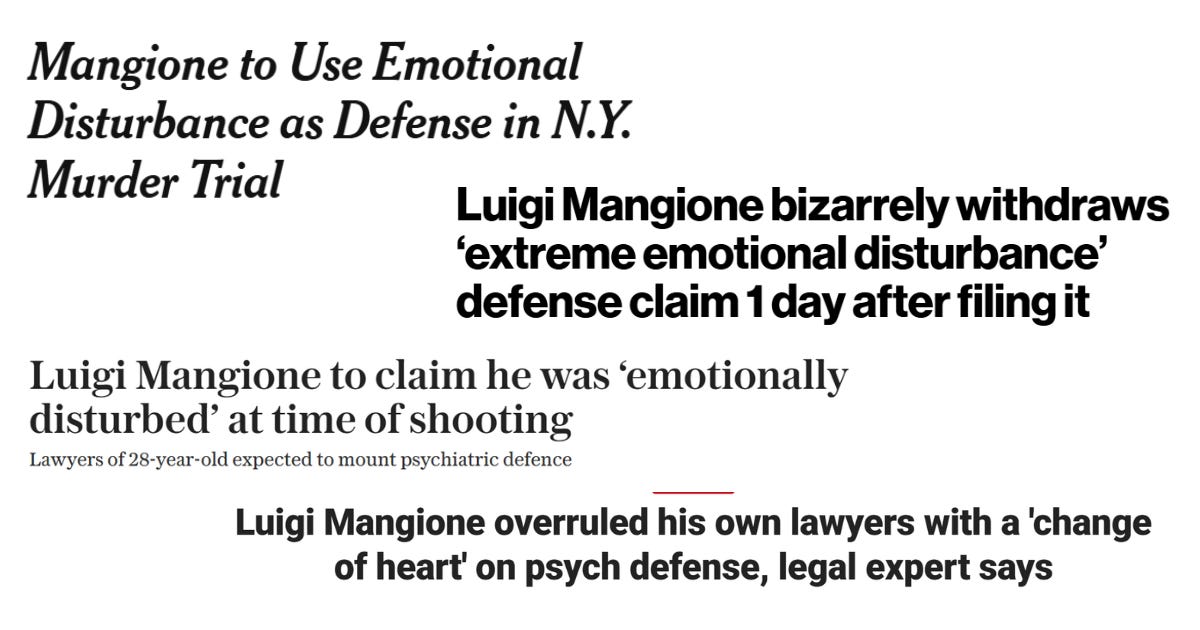
Comments on these articles immediately conflated Extreme Emotional Disturbance with pleading insanity (not the same thing. Then came the armchair lawyers and online legal commentariat with their stone cold takes. One such spectator (a public defender in their day job, no less) claimed that, essentially, Luigi had now confessed (he hadn’t).
Which begs the question: if even a working attorney can be incentivized not to discern legal fact from fiction, then what are we all doing here? How can a normal member of the New York public be expected to unlearn every bias they may have accumulated over the past eighteen months of misreports? It’s a subject we touched on in our last article, Justice: A Dish Best Served-, in which we discussed the voir dire process.
We can disregard a lot of what the media says about a lot of topics. We know not to believe that so-and-so is pregnant and not to believe that the two breakout stars of a hit TV series are about to get married, but we trust our institutions, law enforcement, and crime journalists to report the truth.
Because what is said in court should be the truth. Accusations against a defendant should be backed up with evidence. One jurisdiction should not be interfering in the proceedings of another which they are not party to. And legal proceedings should be reported with due care and accuracy.
No matter where you stand on Luigi’s guilt or innocence, a fair trial is an absolute right of any defendant. Transparency is the right of the public. But if prosecutors, the court system, and big media outlets don’t want to play by the rules?
Well, you take it to the appellate courts. But more on that next time. For now, know that this call is being recorded.